The Worm that Wouldn't Die
The Demise and Resurrection of the Planarian

Planarians are flatworms, a few centimeters long, with soft bodies, and typically found in or around water. They are evolutionarily successful, with hundreds of species found around the world. Despite their small size, most planarians are carnivores that prey on insects, larvae, and other small invertebrates. They have a simple type of nervous system, with a collection of ganglion and photoreceptor cells in one part of the body serving as its brain, and a few nerve cells extending throughout the body. They have no circulatory or respiratory systems, instead absorbing oxygen through their body wall. The intestine of planarians is a closed sac, meaning that both food and excrement pass through the same opening.
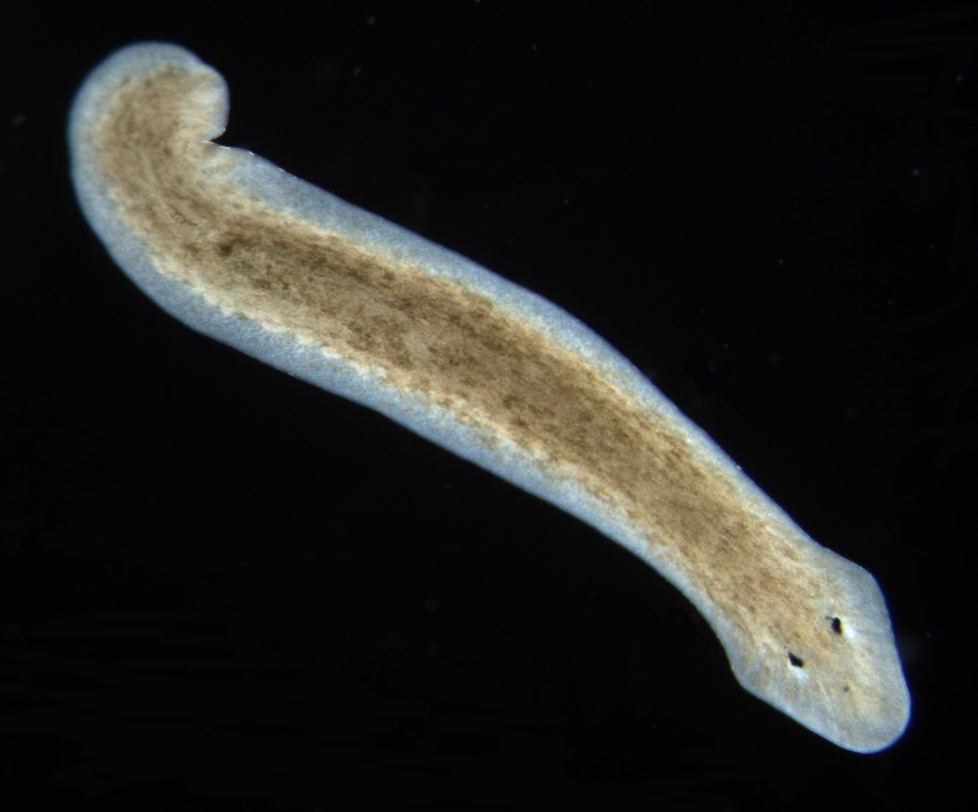
As if this were not enough to convince you that we are dealing with an animal very different than us, something even more remarkable about planarians has long captured the attention of scientists. These simple flatworms have an extraordinary capacity to regenerate their original form following injury or amputation. This goes beyond the abilities of some species to grow back a tail or a limb. What make planarians so remarkable in this regard is that the severed part of the animal grows into a duplicate version of itself. Slice it into 100 pieces and produce 100 planarians, prompting the 19th century biologist Dalyell to remark that planaria “are immortal on the edge of a knife.”
Entire bodies regenerating from scraps may sound more like science fiction than science, but planarians have been a focal organism in research in regenerative biology since the early 20th century, most recently in stem cell research. They have also been studied for many years by neuroscientists due to this astonishing fact: when a planarian is dissected in a way that separates the brain from the rest of the body, even the end without the brain will grow into a full organism with a brain. That is, the brain is not required for a subsequent genetically identical copy with a brain to be produced.
Invertebrate learning
Apart from these questions about regeneration, planarians have played an important role in the comparative psychology of invertebrates. It was once thought that invertebrates like planaria were incapable of learning. The orthodox view of animal learning in the 1950s was that only vertebrate animals could learn from experience. Thus, when reports of learning in planaria first appeared in the scientific literature in the 1950-60s, they were met with skepticism and critique. And to be fair to the critics, some of these early studies lacked appropriate control conditions to rule out alternative explanations. The criticisms motivated better experiments with proper controls, providing more solid evidence that planarians can learn from experience. Neil Deochand and colleagues have published an interesting review of this line of research (Deochand et al., 2018). These better controlled experiments also provided a kind of methodological blueprint for subsequent studies of invertebrate learning that still stand today. Such invertebrate learning is no longer questioned, and there is now solid evidence of learning in a range of invertebrates, from insects to cephalopods.
A prominent figure in early behavioral work with planaria was a comparative psychologist named James V. McConnell. Mark Rilling (1996) provides a fascinating historical account of this era. McConnell was a gifted public speaker and popularizer of psychology, appearing in interviews and articles in the popular press and television, in addition to his planarian research in the lab. McConnell the public figure did not experience the same constraints on his claims as did McConnell the scientist, and he was known for overgeneralizing the findings from his and others’ research, promising more than the psychology of the time could deliver. In the lab, McConnell became involved in a controversial line of research in which planarians were ground up and fed to other planarians to test for memory transfer from original to copy. McConnell reported some evidence for transfer, but the results were challenged on methodological grounds for not including proper control conditions; replication failures mounted. Although McConnell remained a popular figure in the public eye, the cannibalization research did little for his scientific reputation and behavioral work with planarians slowed to a trickle.
The return of the planarians
More recent experiments have picked up where the old studies left off, while also incorporating more recent theoretical developments. Perhaps the clearest evidence of planarian learning comes from experiments by Jose Prados and colleagues at the University of Leicester in the United Kingdom. Here’s how the basic experimental setup worked. Brown planaria (Dugesia tigrina) received presentations of an initially neutral stimulus, a light, and a brief mild electrical stimulation – technically, an unconditional stimulus (US), a stimulus that produces a reflexive response on its own (i.e., without conditions). The reflexive response in this case is a flexion response, a brief period of contraction and inactivity. The researchers were interested in whether the reflexive function of the stimulation would transfer to the light (i.e., whether the light would come to elicit the flexion response on its own). This would provide the best evidence for learning.
One group of worms received the light just prior to the stimulation whereas the other group of worms received the same number of stimulus presentations but in an unpaired fashion. The only difference between the groups of worms was in the contingent relation between the light and the stimulation, whether the light signaled the upcoming stimulus or not. This contingency made all the difference: Worms in the contingent group came to respond to the light as they did to the stimulation itself, whereas worms in the control group did not. Later experiments in the same paper extended these basic findings to even more complex forms of Pavlovian learning, blocking and overshadowing, in which individual stimuli presented together in a stimulus compound compete for influence over the learned behavior. These, too, showed results consistent with other species and stimuli.
That simple flatworms show fairly complex forms of Pavlovian learning shows just how general these processes are throughout the animal kingdom. They also show just how little neural hardware is needed for such learning to occur. The simplicity of the nervous system, coupled with an extremely adaptive form of learning, makes the planarian an especially attractive model species for understanding the neural underpinnings of learning.
Extraordinary claims
Given the remarkable regenerative properties of the planarian, one might well ask whether any parts of the learning history might be preserved in the copy. Prior to the fateful cannibalization research, McConnell reported some evidence of transfer of conditioning from original to copy (McConnell et al., 1959), but this line of work was not sustained, perhaps caught up in the backlash over the cannibalization research.
More recently, a study by Shomrat and Levin (2013) claimed that learning prior to decapitation may survive: differential responding prior to the split was also evident in the copy when tested after 14 days of development (the time need to reconstitute). Moreover, the results were the same whether the clone was regenerated from the head or tail portion of the original worm. That is, animals cloned from the tail portion performed as well as those cloned from the head. This result, too, was reported by McConnell (1959).
As intriguing as these results are, much additional research is needed. As Carl Sagan once said, “extraordinary claims require extraordinary proof.” Claims of memory transfer across animals certainly counts as an extraordinary claim. Unfortunately, the Shomrat and Levin study had a number of shortcomings that limit some of the more striking claims. To begin with, they used a rather crude behavioral task and only reported group-level differences (% of animals in each group to reach criterion). It was thus not possible to know how individual worms (or their copies) responded to the contingencies. A more rigorous analysis of individual behavior before and after dissection would provide more compelling evidence of transfer across animals. Before we can even pose the question of transmission of prior learning across organisms, we need a far better understanding of planarian learning abilities that goes beyond the few simple behavioral preparations used to date.
Work in this area will advance most quickly with more sophisticated behavioral methods. What is needed is research that combines robust and well understood behavioral preparations, like the Pavlovian conditioning procedures from Prados and colleagues, with regeneration techniques of Shomrat and Levin. If such research were done using rigorous behavioral methods, the implications would be far reaching, however the results turned out.
The comparative method
Putting aside the regeneration part of the story, planarians have much to teach us about the cross-species generality of learning principles. At first glance, it may not seem that we have much in common with planarians, so different are our perspectives on the world. But one thing planaria share with us – and indeed all other animals on the planet – is a capacity to learn from experience.
The ways in which that learning is revealed may look very different for different species with vastly differing body types, nervous systems, and evolutionary histories, but the very fact that similar processes apply to such a diversity of species shows just how fundamental these processes are to adaptive functioning. This is one of the reasons studies with wide ranging species – including those that are strange and unfamiliar to us – are so important: they show us how far basic principles can be applied across the animal kingdom.
This perspective on continuity puts us in the best position possible to see the consistencies across species, when and where they exist, while also appreciating differences in the ways in which those behavioral regularities may play out for a given species in a given habitat. Abramson and Wells (2018) remind us that it is important to look not only to the striking similarities between species but also to the sometimes striking differences. This back and forth between similarities and differences is at the heart of the comparative method. In future posts I plan to explore other learning phenomena from a comparative perspective, showing how far simple learning processes can take us in understanding complex behavior.
Further reading
Abramson, C. I., & Wells, H. (2018). An inconvenient truth: Some neglected issues in invertebrate learning. Perspectives on Behavior Science, 41, 395-416. doi: 10.1007/s40614-018-00178-8
Deochand, N., Costello, M.S., & Deochand, M. E. (2018). Behavioral research with planaria. Perspectives on Behavior Science, 41, 447-464. doi: 10.1007/s40614-018-00176-w
McConnell, J. V., Jacobson, A. L., & Kimble, D. P. (1969). The effects of regeneration upon retention of a conditioned response in the planarian. Journal of Comparative and Physiological Psychology, 52, 1-5. DOI: 10.1037/h0048028
Prados, J., et al. (2013). Cue competition effects in the planarian. Animal Cognition, 16, 177-186. DOI: 10.1007/s10071-012-0561-3
Rilling, M. (1996). The mystery of the vanished citations: James McConnell’s 1960 quest for planarian learning, a biochemical engram, and celebrity. American Psychologist, 51, 589-598. https://doi.org/10.1037/0003-066X.51.6.589
Shomrat, T., & Levin, M. (2013). An automated training paradigm reveals long-term memory in planarians and its persistence through head regeneration. Journal of Experimental Biology, 216, 3799-3810. https://doi.org/10.1242/jeb.087809
Great article, informative, interesting. Thanks
So interesting! Love this! Planarian are fascinating — as was J. McConnell. He wrote a short story about a guy living in a box being trained and the reinforcement is milk spouting from a massive breast on the side of the box, if I recall correctly. He also was one of the Unabomber’s victims!